
Nine mental models turned into a knowledge graph

Last year I wrote nine articles on mental models.
I just recently dropped them into a tiny knowledge graph, mostly out of curiosity. I wanted to see what would happen once they were all in one place.
Even with only nine models, the graph didn’t look evenly distributed. A few models sat in the middle and touched almost everything else, while the rest formed smaller clusters around them.
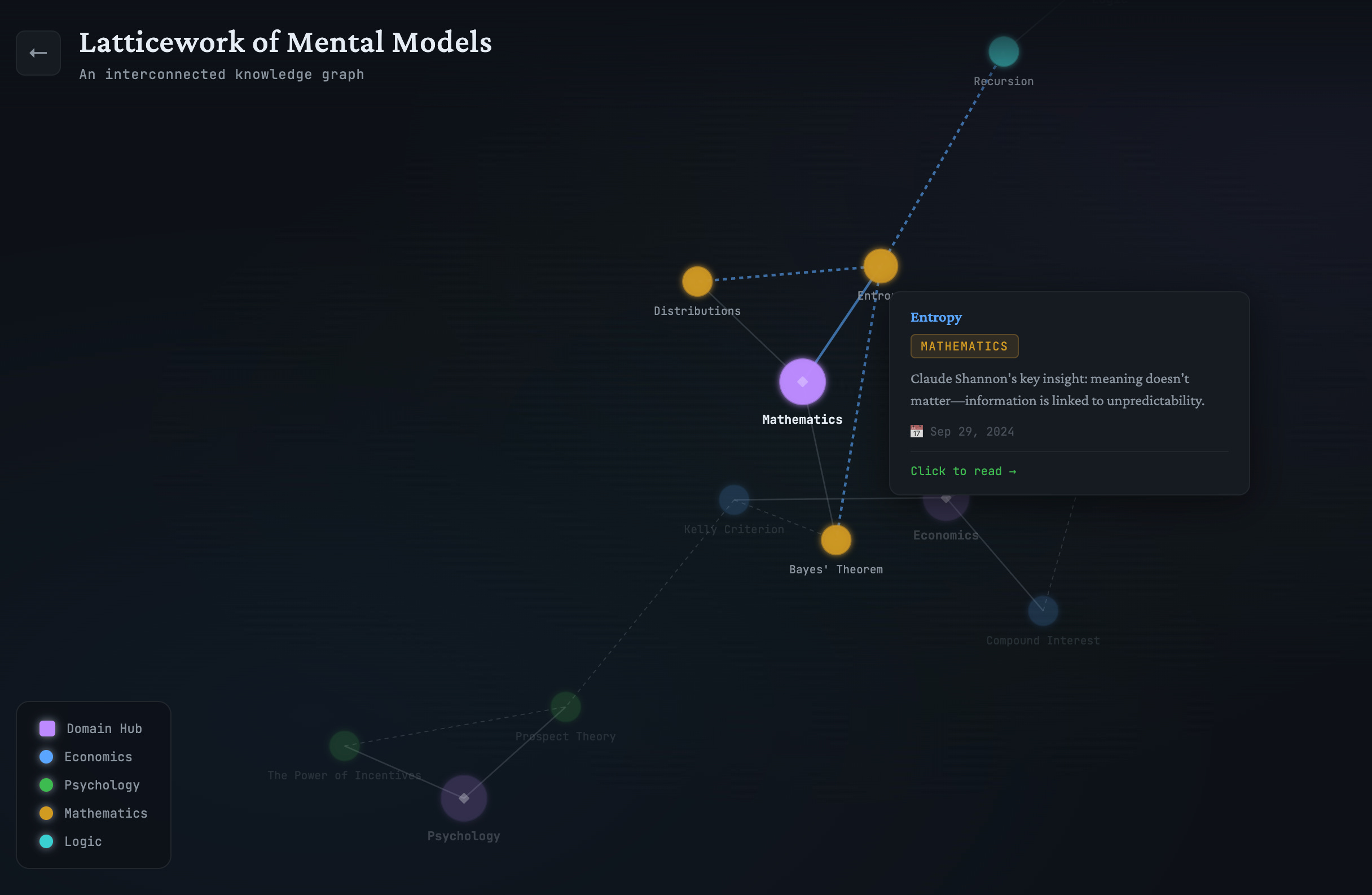
That’s not profound, but it is useful.
Because when you see your models laid out like this, they stop being a list and start behaving like a system. You can feel where the “load-bearing” ideas are. You can also see which concepts you keep orbiting and which ones never connect to anything else (which is often a clue).
I made the graph interactive and here is the link if you are interested
Interactive graph: https://weijian.ai/lattice-graph.html
The underlying idea: Zettelkasten
Under the hood, this is basically a Zettelkasten-style approach:
a “navigable lattice” of notes and links.
The format I like is:
A small number of curated hub pages (“Maps of Content” / MOCs)
Intentional cross-links between hubs
A consistent template per note so links aren’t just vibes
Think “hub-and-spoke,” with bridges.
For example:
Mathematics models: Entropy, Bayes’ theorem, distributions…
Economics models: Compound interest, big debt cycle, Kelly…
Psychology models: Incentives, prospect theory…
Then you deliberately connect them.
Example: “Probability under uncertainty” becomes a bridge linking
math ↔ economics ↔ psychology, because that’s where a lot of real decisions live.
The point is to make your knowledge traversable.
How I build it from Substack (RSS → graph)
I didn’t want heavy tooling. I wanted something I could maintain.
So the workflow is:
Substack RSS (XML) → Python script → Interactive HTML (D3.js)
…and a small manual file for “these two models are related.”
There are two kinds of connections:
Automatic connections (based on your existing labels / tags / categories)
Manual cross-links (a simple
crosslinks.jsonfile you edit over time)
If you try this, start small
You don’t need 200 posts. I had nine.
Pick your first hubs (your existing categories are fine), add a simple per-note structure, then cross-link aggressively.
If you build one, I’d love to know: Which mental model becomes your “central node”? :)