
Paper Fluff Cutter

Paper Fluff-Cutter is a command-line tool for stripping academic papers down to their explanatory core.
Install:
pip install fluff-cutterConfigure:
fluff-cutter initBasic Usage:
fluff-cutter analyze paper.pdfInput: a PDF research paper
Output: a concise analysis answering three non-negotiable questions:
Why should I care?
What is the actual innovation?
Is there sufficient evidence to support it?
If a paper can’t survive those three, it’s probably not worth further attention.
Repo: https://github.com/weijianzhg/paper-fluff-cutter
(PyPI package: https://pypi.org/project/fluff-cutter/)
Motivation
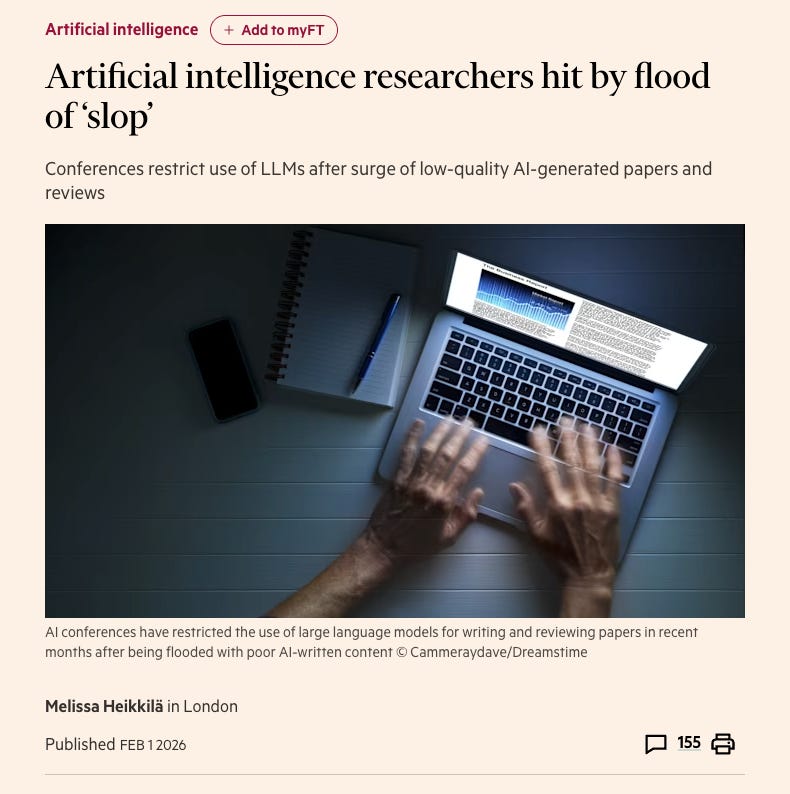
Most modern research output is noise. Publish-or-perish turns papers into units of career progression rather than attempts to explain reality. Once you add AI into that system, the volume explodes while the signal density collapses.
This work isn’t anti-research. It’s pro-explanation.
Popper and Deutsch make the point clearly: research is about producing better explanations of reality. Most papers today fail that test. They rephrase or extrapolate instead.
That gap between what research claims to do and what it actually delivers is the reason this tool exists.
Goal
Build a tool that strips a paper down to its incompressible core.
Just answers to three questions that every paper must survive:
Why should I care?
What is the actual innovation or proposal?
Is there sufficient evidence to support it?
If a paper can’t answer these cleanly, it’s not worth more time.
Design
CLI first
I don’t believe bespoke UIs have much of a future. This tool should be callable by humans and by other AI agents.Multimodal
Modern LLMs can read PDFs directly (figures, tables, and diagrams included). No lossy text-only preprocessing any more.
Implementation
The implementation is intentionally simple.
The tool accepts a PDF path
The PDF is passed directly to a multimodal LLM
A tightly scoped prompt enforces evaluation against the three core questions
Output is a concise, structured summary in Markdown format.
Simplicity is a feature here.
Early Results
Here are some outputs with Claude Sonnet 4.5. The results were genuinely good.
Paper: Semi-Autonomous Mathematics Discovery with Gemini (https://arxiv.org/abs/2601.22401)
Output:
## 1. WHY SHOULD I CARE?

This paper tests whether AI can autonomously solve open mathematical problems—specifically, problems from Paul Erdős's famous collection. If AI could reliably solve genuine research problems, it would accelerate mathematical progress significantly. However, the paper reveals a sobering reality: **most "open" problems the AI solved were either trivial, already solved in obscure literature, or based on flawed problem statements.** This matters because it exposes critical limitations in current AI-for-mathematics systems and warns against premature hype about AI "solving" research problems.

The broader lesson: AI-generated solutions face challenges humans rarely encounter—**subconscious plagiarism** (reproducing training data without attribution), difficulty verifying novelty against vast literature, and sensitivity to ambiguous problem formulations.

## 2. WHAT'S THE ACTUAL INNOVATION?

**Core approach:** The team deployed "Aletheia" (a math agent built on Gemini Deep Think) on 700 "open" Erdős problems. They used AI-based natural language verification to filter 700 problems → 200 candidates → 63 technically correct → **13 meaningfully correct** solutions.

**Key classification of results:**
- **2 autonomous solutions** (652, 1051) - though 652 is trivial reduction to literature
- **3 partial solutions** (654, 935, 1040) - solved parts of multi-part problems
- **3 independent rediscoveries** (397, 659, 1089) - correct but already published
- **5 literature identifications** (333, 591, 705, 992, 1105) - found existing solutions

**What's different:** This is one of the first systematic studies applying frontier LLMs to a large corpus of open research problems with transparent reporting of **failure rates** (68.5% fundamentally flawed, only 6.5% meaningfully correct). Most AI-math papers cherry-pick successes; this paper honestly documents the full pipeline.

**The innovation isn't a breakthrough—it's a cautionary reality check.** The paper shows that:
- "Open" often means "obscure" not "difficult"
- Human expert time becomes the bottleneck (verifying correctness AND novelty)
- Problem statement ambiguity trips up AI far more than humans

## 3. IS THE EVIDENCE CONVINCING?

**Strengths:**
- **Transparent methodology:** They show the full funnel (700→200→63→13) with error analysis
- **Honest downgrading:** Several initially claimed "novel" solutions were later found in literature during peer review
- **Reproducibility:** Raw AI outputs will be uploaded; solutions are human-rewritten but mathematically unchanged

**Critical weaknesses:**

1. **Cherry-picking remains:** Even with 13 "meaningful" solutions, the authors admit none individually "rises to the level of a research paper"—several are "graduate student exercises." The most substantive (Erdős-1051) is explicitly noted as only "slightly non-trivial."

2. **Novelty verification is incomplete:** The authors candidly state they likely missed earlier solutions. For problems like 397, 659, the "independent rediscovery" could actually be training data leakage they can't detect.
Paper: DeepSeek OCR (https://arxiv.org/abs/2510.18234)
Output:
## 1. WHY SHOULD I CARE?

**The Problem:**
Large Language Models struggle with long text sequences because processing text is computationally expensive (quadratic scaling). When you have long documents, the compute cost explodes.

**Why It Matters:**
This paper explores a radical idea: what if we could compress text by converting it into images? Think about it—a single document image can represent hundreds or thousands of words using far fewer "tokens" than the raw text. If this works, it could:
- Make processing long documents 10-20× more efficient
- Enable LLMs to handle much longer contexts without hardware upgrades
- Provide a "memory forgetting" mechanism that mimics human memory (recent stuff stays sharp, old stuff gets blurry)
- Generate massive amounts of training data efficiently (200k+ pages/day on a single GPU)

This isn't just academic navel-gazing—it's about making AI systems cheaper and more capable at handling real-world document workloads.

## 2. WHAT'S THE ACTUAL INNOVATION?

**Core Idea:**
Instead of feeding raw text to an LLM, render it as an image, then use a vision encoder to compress it into very few "vision tokens" that a language model can decode back into text. It's like ZIP compression, but using images as the compression format.

**What Makes It Different:**
1. **DeepEncoder architecture**: They chain together a lightweight window-attention encoder (SAM) with a heavier global-attention encoder (CLIP), connected by a 16× compression layer. This keeps memory usage low even at high resolutions.

2. **Multiple resolution modes**: The system supports different compression ratios (64 to 1800+ vision tokens) depending on how much text you're compressing.

3. **Quantitative compression analysis**: Unlike other OCR models, they systematically test: "For 1000 text tokens, how many vision tokens do we actually need?" Answer: ~100 vision tokens gets you 97% accuracy (10× compression).

**In Plain Terms:**
Take a page with 1000 words. Normally an LLM needs ~1000 tokens to process it. They show you can render it as an image, compress it to ~100 vision tokens, and still recover 97% of the text accurately. At 20× compression (50 tokens), you still get 60% accuracy.

## 3. IS THE EVIDENCE CONVINCING?

**What They Provide:**
- **Compression study**: Tested on Fox benchmark with 100 pages (600-1300 text tokens). Shows clear degradation curve as compression increases.
- **Practical benchmarks**: On OmniDocBench, outperforms GOT-OCR2.0 while using fewer tokens, matches state-of-the-art with <800 tokens vs competitors using 6000+.
- **Production metrics**: Claims 200k+ pages/day processing on single A100 GPU.

**Weaknesses and Gaps:**

1. **Limited compression validation**: The Fox benchmark is only 100 pages, all relatively short (600-1300 tokens). Where's the test on 10,000+ token documents? The most interesting compression scenarios aren't thoroughly tested.

2. **Format mismatches inflate errors**: They admit "the output format still cannot completely match Fox benchmarks, so the actual performance would be somewhat higher." This is a red flag—their reported accuracies are artificially low due to evaluation issues, not compression limits.

3. **No real context compression test**: They claim this is useful for "long-context compression in LLMs" but provide ZERO evidence of actually using this in an LLM context window. No needle-in-haystack tests, no RAG experiments, no multi-turn dialogue compression—they acknowledge this themselves.

4. **The "forgetting mechanism" is pure speculation**: Figure 13 presents a beautiful theory about progressive image downsizing mimicking memory decay, but it's entirely untested. Cool idea, zero validation.

5. **Cherry-picked comparisons**: They compare against models using different encoders and resolutions. The "fewer tokens" advantage partly comes from their specific architectural choices, not necessarily the compression paradigm itself.

**Bottom Line:**
The evidence supports that their OCR model is efficient and competitive—that part is solid. The broader claims about "contexts optical compression" for LLMs? Those are interesting hypotheses backed by limited proof-of-concept data, not convincing demonstrations. This is honest exploratory research, but the title oversells what they've actually validated. The real contributions are: (1) an efficient OCR architecture, and (2) initial quantitative bounds on vision-text compression ratios for document OCR specifically.
Finally
(I hope) AI might save research by making it impossible to hide behind padding. This tool is a small step in that direction.